
Would you like to travel around space? A memory of a fun little trip around the orbit of the Earth is most certainly an out-of-this-world experience. Perhaps, if you have 55 million lying around, you absolutely can do space tourism! A high budget can buy you a seat on a private spaceflight, a short weightlessness experience, or, in rare cases, a trip to orbit on the International Space Station. But think twice before spreading your money around, you should know that space traveling can make you sick. Right as you read this, there is a very high possibility that there are viruses that are hiding inside of you. And if you are in space long enough, they can wake up…
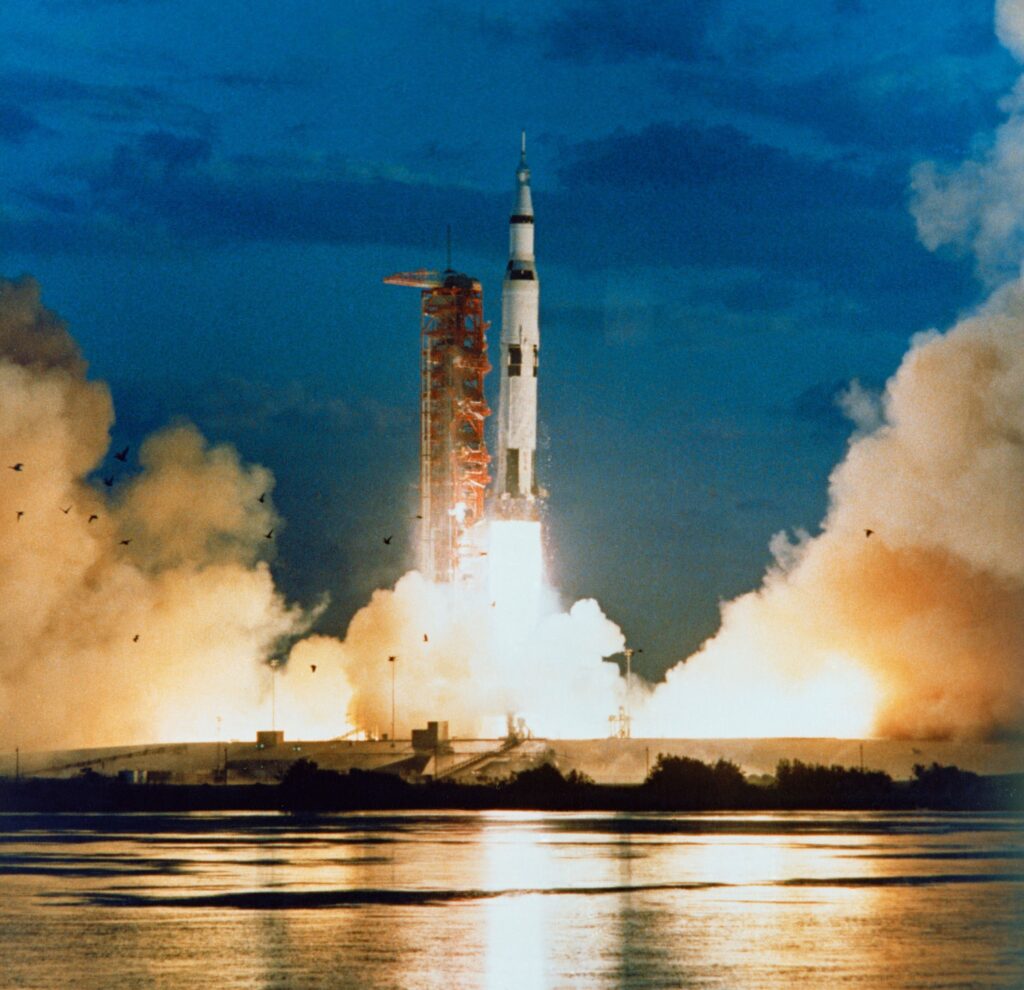
It all started with the Apollo Missions…
In the 1960s, the Apollo missions began, and astronauts were sent into space. However, what early astronauts didn’t realize is how important gravity itself is for the function of our immune systems. Because, within a few days, NASA was alerted that Rusty Schweickart, a prior astronaut involved with the mission, was experiencing symptoms of illness [1]. That’s when the researchers came across one of the most interesting physiological occurrences of all time, space adaptation syndrome (SAS).
“It appears that microgravity-associated changes, including neurovestibular adaptation and fluid shifts, can cause symptoms and affect health” [5]. Through SAS, they later learned that entering and leaving non-gravitational areas can cause astronauts to experience sickness, so to monitor their well-being, they began collecting saliva, blood, and urine samples from the astronauts before, during, and after spaceflight. Illness is something expected from the astronauts; they experience high stress levels due to their missions and separation from their normal lives. What’s interesting is how dormant viruses, such as herpes or Epstein-Barr, awake in this scenario.
A hypothesis on what the cause could be is how gravity affects blood circulation. Let’s draw a picture of what could be happening within the astrounats. The gravity that usually pulls the blood downwards disappears. Without that pressure, the immunity cells in your blood start to “swim” around your veins, rather than going to a point focused destination. It is even theorized that the fluid inside the immune cells needs gravity, as they cannot alert in case of an “intruder attack”. Normally, when a virus infects a cell, that cell takes little pieces of the virus and moves it to the outer layer of the cell, where it can signal to the body that it is affected. Then the body would tell the cell to “sacrifice” itself to protect the body (apoptosis). Unfortunately, in the astronauts’ case, because of the lack of gravity, this cannot happen. Ergo, the reason why astronauts get infected.
Another hypothesis is how these viruses actually infect us in areas where the immune system is not active, like the eyes, nerves, and the brain. With viruses like herpes or such, the difference is that they can prevent the body from “sacrificing” the infected cell. But, wouldn’t this mean that the body is still infected? Yes, but also, not necessarily. These viruses can choose to hide their genomes in our cells’ nuclei, where our genetic code is stored. This way, they make our bodies do the “dirty job” of getting the code read and spread in our bodies. Very smart, though not smart enough. Our magnificent bodies “silent” these viruses by tightly packing them around proteins. This way, their genome does not get read, and the virus gets into a sleep mode (latent phase). The tricky part is that the virus is still there, so we are still infected. Even though it is not fully understood what causes these viruses to awaken, it is theorized that the cellular stress the astronauts go through because of the sudden temperature changes and the solar radiation rate may be a reason for these tightly packed proteins to loosen their grip, letting the viruses awaken [3]. Normally, when this happens, our immune system would just catch the viruses and “sacrifice” itself. But what happens if our immune systems also do not work? Well, that’s when astronauts get space herpes. NASA discovered this through the saliva samples they started to collect after the Apollo mission.
This was the full cycle story of “space herpes” and how dormant viruses awaken. Hope you enjoyed!
For more information, see the following videos!
Resources:
[1]
E. Carney, “In the Apollo and Skylab Days, Astronauts Didn’t Get Sick. Until They Did.,” Medium, Jan. 14, 2026. Available: https://medium.com/the-making-of-an-ex-nuke/in-the-apollo-and-skylab-days-astronauts-didnt-get-sick-until-they-did-64bbdf0534bd
[2]
Cleo Abram, “Viruses Are Waking Up in Space,” YouTube, Mar. 18, 2026. Available: https://www.youtube.com/shorts/ydpwFR5A-cg. [Accessed: Mar. 19, 2026]
[3]
SciShow, “How Space Awakens Sleeping Viruses,” YouTube, Jul. 16, 2025. Available: https://www.youtube.com/watch?v=zaRlZtUNMl8. [Accessed: Apr. 22, 2026]
[4]
L. E. Low, “NASA Investigates How Dormant Viruses Behave During Spaceflight – NASA,” nasa.gov, Mar. 21, 2019. Available: https://www.nasa.gov/humans-in-space/nasa-investigates-how-dormant-viruses-behave-during-spaceflight/
[5]
“Space Adaptation Sickness (SAS) and Space Readaptation Syndrome OCHMO-MTB-004 Rev A.” Available: https://www.nasa.gov/wp-content/uploads/2025/09/ochmo-mtb-004-space-adaptation-sickness-sas.pdf?emrc=4356a2
[6]
D. A. Payne, S. K. Mehta, S. K. Tyring, R. P. Stowe, and D. L. Pierson, “Incidence of Epstein-Barr Virus in Astronaut Saliva During Spaceflight,” Nasa.gov, 1998. Available: https://ntrs.nasa.gov/citations/20000086223. [Accessed: Apr. 22, 2026]
[7]
S. Mehta, “AB014. Dormant viruses activate during spaceflight—NASA investigates,” Pediatric Medicine, vol. 3, pp. AB014–AB014, Feb. 2020, doi: https://doi.org/10.21037/pm.2020.ab014
Leave a Reply