
These are some of the questions you start asking yourself when you dig deeper into trying to find “sustainable” solutions to modern-world problems. The truth is, you can give so many right answers depending on the specialization you look at it from. This is also the exact reason why these questions created a heated debate at COP31.
In search of an answer, I would like to share a new concept I have learned that shattered my worldview completely.
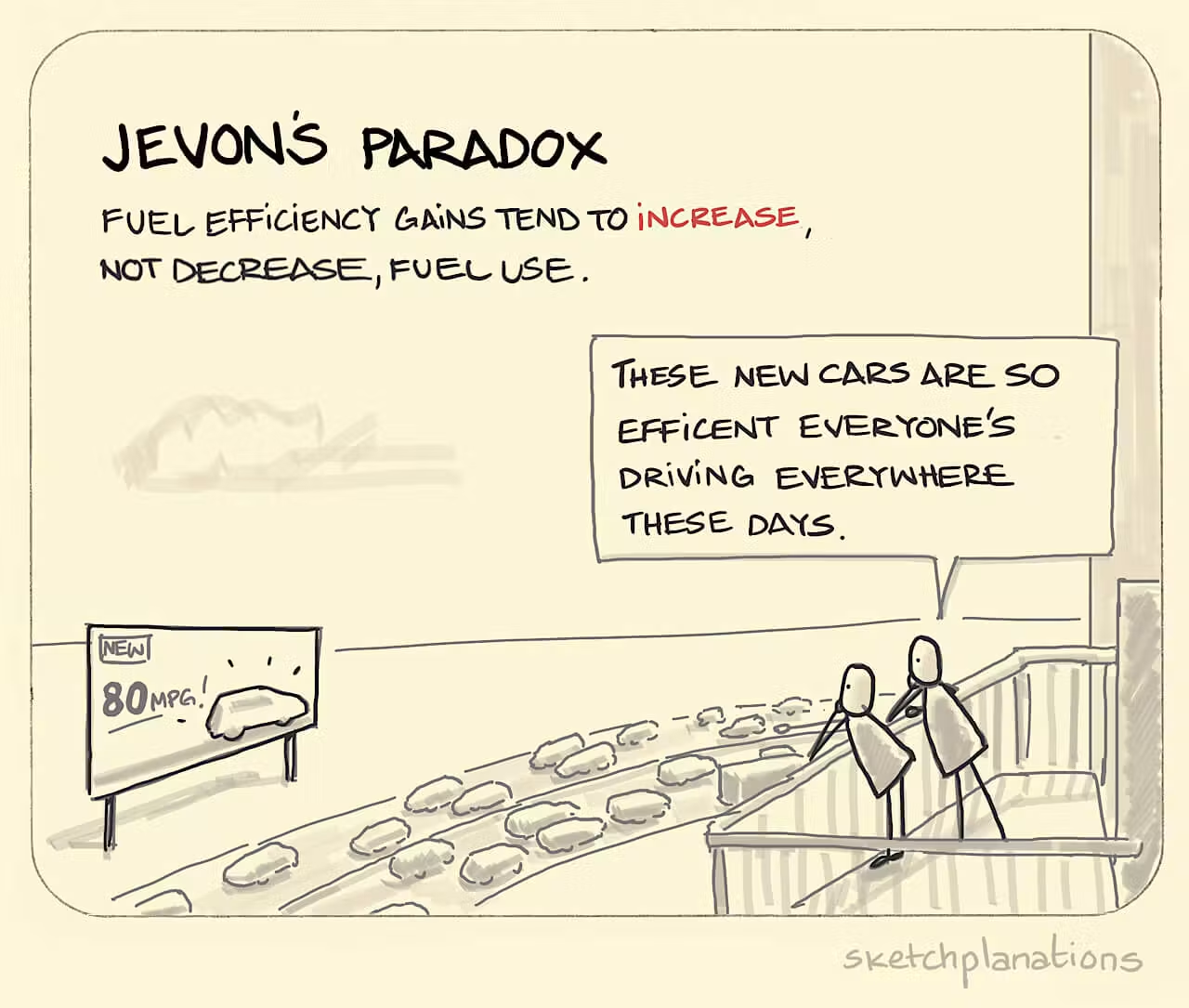
” The Jevons Paradox”
This idea teaches us that efficiency increases demand. New technologies allow us to use resources more efficiently, but ironically, we end up using the resource more for the exact reason.
We were taught that the definition of sustainability is using resources in a manner that will leave some for the upcoming generations. In this chain of thought, sustainability does not exactly exist, does it? Because human behaviour points out that we are trying to solve issues that we create, and causing more problems in the meantime…
No matter where I look at this paradox from, it always ends up in a problem related to societal structures and behavioral issues. As my researcher once said, “there is no evidence in the history of Earth that humankind solved anything; we should stop assuming that we have answers when the evidence clearly shows that we caused problems all along”.
After long hours I have spent doing desk research and talking to researchers about their experiences in the field, I came to realize there is no exact solution to Jevons Paradox. We also know that as long as economic growth is a major political goal, a sustainable net-zero emissions future will always come second. Because, correct me if I am wrong, it seems like the current capitalist system is too powerful and complex to be reshaped that easily.
So what do we do? We mitigate.
We try to find ways to have economic growth without high levels of energy consumption; one way to do this could be finding sources with the least rebound effect. Or, if possible, no rebound effect.
Or even better, we find value in things relevant to economic growth, but it doesn’t necessarily create energy demand.
The thing is, relative decoupling is common, but absolute is very rare. Researchers estimated that final energy needed for decent living for the whole world population in 2050 could be over 60% below today’s consumption [1,2]. That requires advanced technologies and demand reductions to sufficiency levels. This is about well-being per unit of energy, not GDP growth.
This brings me back to the beginning: climate awareness and development could go hand in hand, but not in this decade, and not with our current mindset on constant economic growth.
So…what now? How do we mitigate from this point forward?
…
[1] Millward-Hopkins, J., Steinberger, J. K., Rao, N. D., & Oswald, Y. (2020). Providing decent living with minimum energy: A global scenario. Global Environmental Change, 65. https://lnkd.in/eYVkZGY8
[2] Herring, H. (2013). The Rebound Effect of Energy Conservation. Reference Module in Earth Systems and Environmental Sciences. https://lnkd.in/ezyXsF2b
Leave a Reply