
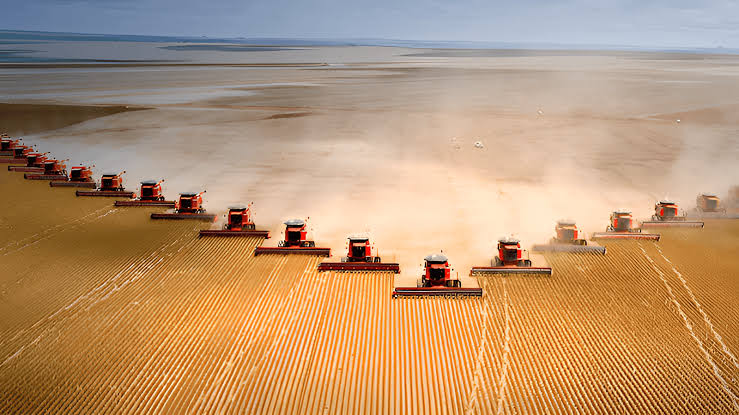
11,700 years ago a major shift had occurred, changing the entire trajectory of human history. People began to cultivate crops. Driven by this agricultural revolution, we were able to move from a nomadic way of life to a permanent one. Humans became the first animals who were able to bend nature to our own needs, rather than simply complying to it. This became our strategy for survival. Living together in settled communities and sharing food.
Throughout the years, we became masters of a skill we adapted to, creating irrigation channels, crop rotation systems and trade routes. Yet, the most drastic turning point for our environment didn’t happen at fields, it arrived with the mechanisation and globalisation of the process.
In the 19th century and especially after World War two (when economies collapsed and the food supplies fell, leading to great famines), governments had to make decisions, and make a decision fast. Their solution, known as the Green revolution, was to use gas-powered tractors, chemical pesticides, high-yield crop varieties, global trade expansion and massive MONOCULTURES (growing single crop on a big land). It worked, saving billions from starvation. But, this rapid victory came with a price, causing severe environmental damages and restoring it would be an extremely difficult task. Nature never grows one plant in total isolation, which is why, forcing the Earth into unnatural monocultures, leaves the crops defenceless against pests. [1, 2]
Main impacts include:
- Soil degradation: due to over-tilling and chemicals which strips away the top-soil. [3]
- Green house gas emissions (contributing to climate change) – account for THIRD of all human emissions. [4]
- Water pollution and depletion – chemical runoff creates dead zones. [5]
- Biodiversity loss – single-crops on farms, clear native animals in the area, which pushes them toward extinction. [6]
In short, we are gambling with our own survival. If we don’t do something in the next 50 years, the foundation of our food system would collapse. If the soil is dead, we cannot grow food. If water is poisoned, we cannot drink it. Etc etc.
But what can we do???
The answer to the question is simple. Returning back to the roots. Global food exports look attractive, seeming cheap in a supermarket receipt, but it releases a large carbon footprint and leaves countries vulnerable to supply chains. If we had a local supply of food in each country and did not transport it that much, this would severely reduce the effect.
To be clear it is a hypothesis that lacks enough comparative research. However, it is built on a logical starting point: cutting down the distance our food has to travel.
Imagine having a local garden in each city, you wake up, go outside and take fresh food from parks, or buildings, and local mini-greenhouses which are placed in each region of a city. This supports small farms, and small companies, creating authentic, real communication in a strong community.
This topic of sustainable agriculture is very vast, and exciting, with research conducted every day. From hydroponics and Regenerative agriculture to Agroecology and permaculture – each of which are nature based. At the core, the goal is to decrease the distance between the farm and people. [7] This will bring back a sense of connection between people and nature, over mechanistic mass production, where people become distant from each other.
There are no villains or heroes in this story, only a system built on a past crisis, no longer works for our future. That system exists because we built it, and the only way to change it is if we decide to rebuild it. Is it hard? Yes. Is it possible? Yes.
Yet, it leaves us with a critical and uncomfortable question: are we willing to change our system and values for the sake of our planet?
…
Sources:
Inspired by:
- Local Futures. The economics of eating. Berkeley (CA): Local Futures; 2026. Available from: https://www.localfutures.org/films/the-economics-of-eating/
References:
- Park I. A timeline of the three major agricultural revolutions in history. Washington (DC): Population Education; 2022 Dec 13. Available from: https://populationeducation.org/a-timeline-of-the-three-major-agricultural-revolutions-in-history/
- National Geographic Society. The development of agriculture. Washington (DC): National Geographic Education. Available from: https://education.nationalgeographic.org/resource/development-agriculture/
- United Nations Environment Programme (UNEP). Five reasons why soil health is declining worldwide [Internet]. Nairobi: UNEP; 2024 Dec 5. Available from: https://www.unep.org/en/news-and-stories/story/five-reasons-why-soil-health-declining-worldwide
- Crippa M, Solazzo E, Guizzardi D, Monforti-Ferrario F, Tubiello FN, Leip A. Food systems are responsible for a third of global anthropogenic GHG emissions. Nat Food. 2021 Mar;2(3):198-209. doi: 10.1038/s43016-021-00225-9.
- U.S. Environmental Protection Agency (EPA). Sources and solutions: agriculture Washington (DC): EPA. Available from: https://www.epa.gov/nutrientpollution/sources-and-solutions-agriculture
- European Parliament. Biodiversity loss: what is causing it and why is it a concern?. Brussels: European Parliament; 2020 Jan 16. Available from: https://www.europarl.europa.eu/topics/en/article/20200109STO69929/biodiversity-loss-what-is-causing-it-and-why-is-it-a-concern
- Thrive Market. 10 examples of sustainable agriculture & farming techniques. Los Angeles (CA): Thrive Market; 2025 Feb 18. Available from: https://thrivemarket.com/blog/examples-of-sustainable-agriculture-and-farming
Leave a Reply